
An Algorithm Called Monet
A long history of perceiving the real, the fake, and the artifact

The story broke a few weeks ago and generated plenty of noise. In brief: a user posts on X a cropped detail from a Monet painting — a water-lilies canvas from 1915, currently hanging in the Neue Pinakothek in Munich — claiming to have generated it with AI in the style of Monet, and inviting commenters to explain in what ways it is inferior, superior, or simply different from the real thing.
Many take the bait enthusiastically, attacking the painting’s lack of depth or its colour choices. A few, to their credit, aren’t fooled, correctly identifying what is, in every sense, a genuine Monet. (We’ll return to that question shortly: is it really a genuine Monet?)
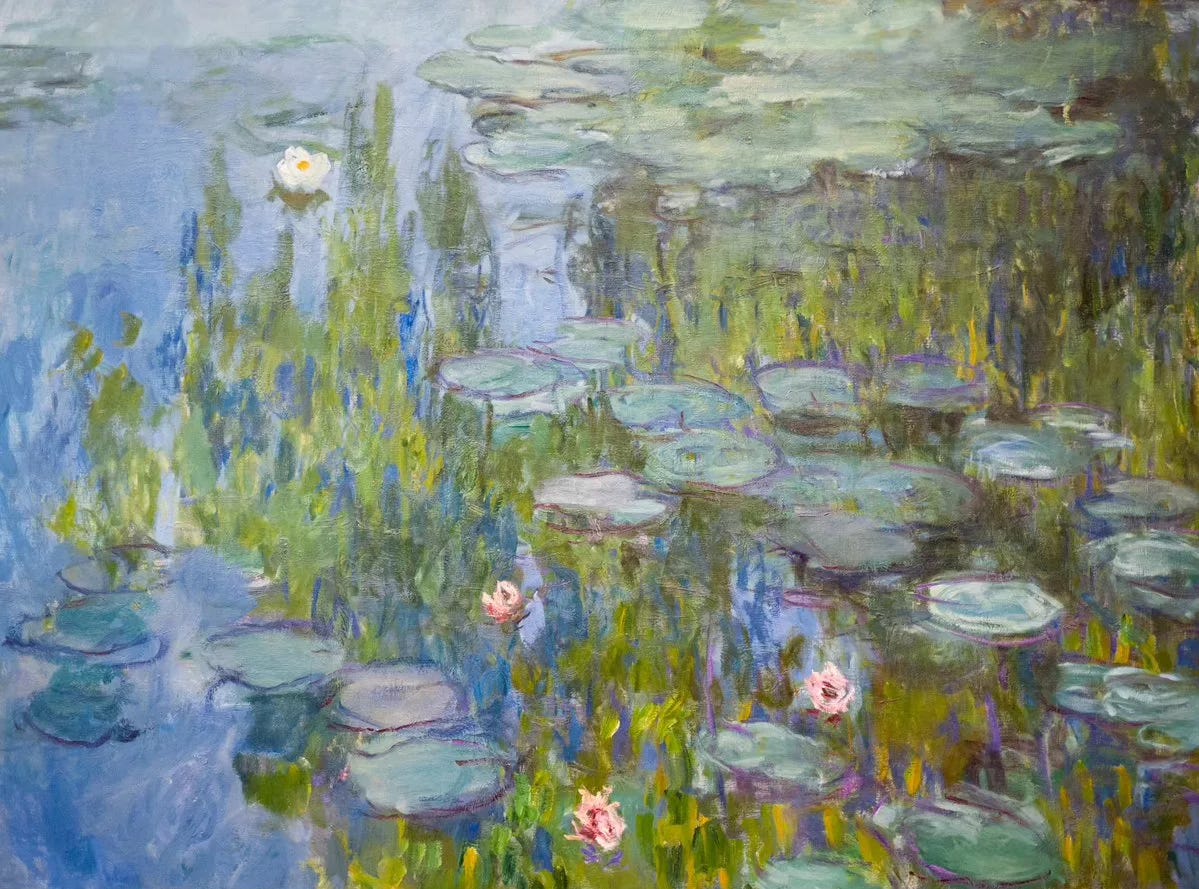
The debate that follows centres on the observation that most people have stopped actually looking at the painting and instead let themselves be guided by the label stuck to it — a point that inevitably widens into a broader claim about every domain of human knowledge where, lacking the competence to separate wheat from chaff, we simply trust what someone else tells us, provided we have already decided to extend that someone a degree of credibility.
What follows makes no claim to completeness or originality. These are my own reflections on the episode, because the whole affair sent me back through a wide set of earlier reading on authenticity, perception, and belief.
The first thing that came to mind was, naturally, Walter Benjamin’s analysis of the work of art in the age of mechanical reproduction, written ninety years ago, long before anyone was talking about AI. By a pleasing coincidence, those were also the years in which Alan Turing was writing his foundational papers on the Entscheidungsproblem and imagining a machine capable of simulating human computation — whether that computation is equivalent to thought is, of course, a separate matter.
Benjamin’s central idea is that the defining quality of the traditional work of art is its aura: the unique presence of the work in the place where it exists.¹ The aura is bound up with the unrepeatable singularity of the work and its material history, and is therefore undermined by the technical possibility of reproducing it in an indefinite number of identical copies. That was the situation of photography and cinema in Benjamin’s day — and it was also, for him, a way of opening space for new political functions of art, breaking the bourgeois monopoly on beauty. Forgeries and fakes have always accompanied art, but until now they have always presupposed the existence of an original, the lie consisting precisely in misrepresenting its origin. With AI-generated work we are often unable to identify or isolate an authentic source to begin from, while the emotional response it produces is equal to, or — studies suggest — sometimes greater than that of a genuine work of art. This probably happens because the modus operandi of artificial intelligence tends to produce results that reflect the statistical average of the vast dataset it draws from, and these results therefore feel to the viewer more reassuring, even more natural, than the occasionally dissonant outputs of a human artist following compositional logic and psychological urgencies rooted in the world and in a personal history.
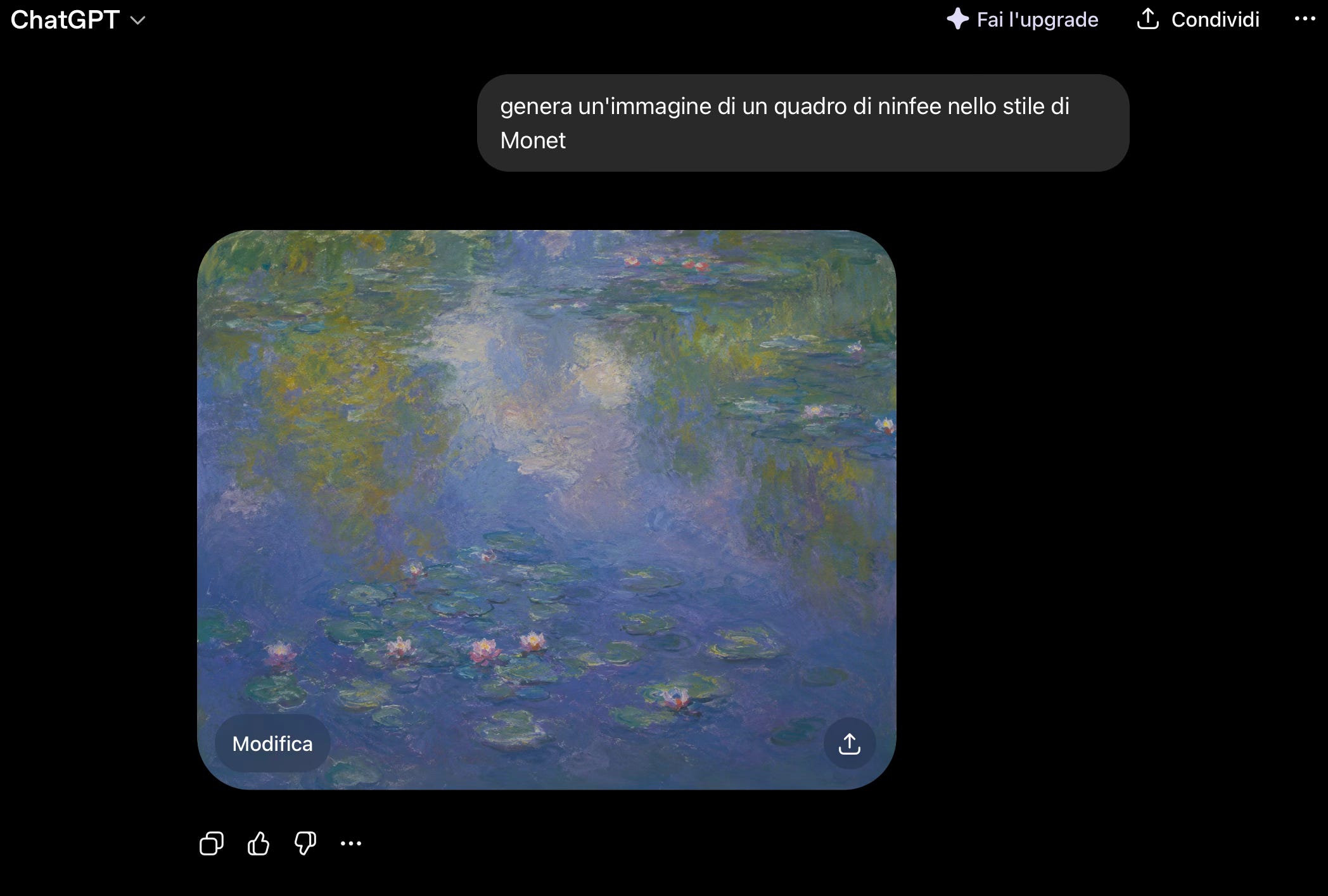
The second thing I thought of was Cromorama, Riccardo Falcinelli’s excellent book, from which I learned that visual perception is a constructive, culturally mediated process — meaning that our perception of colour, for instance, is the result of cerebral processing shaped by context, expectations, memories, and above all by the perceptual education we have received from visual media. Which brings us back to the question I raised above: is that image a genuine Monet? Strictly speaking, the real Monet — the one with the aura, as Benjamin would put it — is in a German museum, and what was the subject of all this debate was a partial reproduction, viewed on the screen of a computer, a tablet, or a smartphone. Falcinelli shows how the chromatic palette of the contemporary imagination has been deeply shaped by the processes of printing, photography, film, and television, and that most of our visual experience is now mediated by a screen, which is itself capable of producing saturations and contrasts that have no equivalent in nature. Since every medium has introduced its own chromatic distortions, its own aberrations and corrections, and since these have become the perceptual norm for entire cultural communities, we now find ourselves in the curious position of considering real facts less real, and plausible artificial facts more so.
It is worth widening the frame at this point. Our perception of the true-fake-true Monet also has something to do with the mechanism of translation. We have known since Schleiermacher — that is, for a couple of centuries — that a translator can either bring the reader closer to the author, estranging them from their own language by immersing them in the original’s horizon, or bring the author closer to the reader, domesticating the text into the target language. The first path produces a translation that is at times opaque but faithful to the spirit of the original; the second produces a fluent text that is really a re-creation dressed up as a translation. Schleiermacher thereby sketches the criteria for an authentic translation: it is one that keeps the translator visible as a mediator. He would have been quite put out by the products of artificial intelligence.
Benjamin too wrote about translation, as one might expect from someone who had thought so carefully about the reproducibility of artworks. The original survives in translation, he argued — it “matures” through it — so that the fidelity of a translation is revealed by how well it captures the original’s mode of signification. What translation must preserve is not the content but the intentional structure of the work. This creates further difficulties when that intentional structure, which is usually accessible to a human reader, must be parameterised and indexed so as to feed into an algorithm implemented by neural networks that work by back-propagation of error, and that must extrapolate not intention but the statistical plausibility derived from the relative weights of neighbouring tokens. Perhaps, though: maybe Benjamin would have found ChatGPT’s water lilies rather pleasing, and deemed them a good translation of the original Monet.
A translation, moreover, may need to operate not only between different languages but — as in our case — between one sign system and another: it can, in other words, be an intersemiotic operation. How does one translate a text into an image, or a piece of music into architecture? Are these comparable languages? The concept was introduced, I believe, by Roman Jakobson in the late 1950s, and it helps us understand what ChatGPT must do when it reads my prompt “generate an image of a water-lilies painting in the style of Monet” and translates it into an actual image. The model performs this operation without having access to the meaning of what I say or of what Monet painted; it works instead on the statistical correlations between textual descriptions and visual configurations, relying on the fact that its library of words and images contains an enormous amount of data to work with. It minimises losses — that is what the model does. Umberto Eco said something similar in Dire quasi la stessa cosa (2003), in which he treats translation as a system of negotiation: there is no “correct” translation, only the translation that minimizes losses according to what one decides to preserve. Life is always an optimization problem, as engineers and economists would say.
At this point the question naturally arises: why do people believe that a genuine Monet is a fake Monet? Before reaching for social psychology, we need to ask what it even means to believe something.
We sometimes believe our dreams, for example. They can be deceiving, yet deceptive dreams can be so plausible that they throw us into confusion — hence the truth-telling ones departing through the gate of horn, and the false ones through the nearly identical gate of ivory, as Homer reminded us in the Odyssey before Virgil borrowed the image in the Aeneid and before Nolan added his own contribution. A little earlier still, Plato had told us how prone we are to mistaking the shadows on a cave wall for more real than the objects casting them.
The philosophy of belief runs to many pages, and it is perhaps worth starting with Spinoza (in the Ethics), for whom understanding a proposition and being temporarily persuaded of its truth are one and the same thing. By default, we believe. It is more economical. Doubt and the suspension of judgement are active operations that require effort, so we doubt only what we have reason to question — and often, it must be admitted, not even that.
Spinoza was echoed, three centuries later, by the work of Daniel Gilbert. The mechanism of belief, Gilbert argues, works like this: in a first phase, the cognitive system automatically accepts a proposition as true; in a second phase — optional, and cognitively expensive — the system may flag the proposition as false or uncertain. In other words, the brain does Spinoza first, and if it has any energy left, it does Descartes. Therefore it is.
We suspend disbelief when we watch a film or read a novel — an operation that Coleridge already identified as necessary for engaging with fiction — but we do it far more often than we think, or than we would like to admit if we consider ourselves analytically rigorous minds.
Kahneman then provides a cognitive framework for all of this. Our brains are equipped with a System 1 that is automatic, fast, unconscious, associative, cheap in cognitive resources, and that produces impressions, intuitions, and first-order beliefs without conscious deliberation. Limping and grumbling behind it comes System 2 — slow, deliberate, conscious, logically structured, and cognitively expensive — which steps in to verify, correct, and inhibit System 1’s responses. And it does so, you can be sure, with a sigh.
The question then becomes: why is a species equipped with sophisticated intelligence so prone to believing false, irrational, and supernatural things? Why has evolution not weeded these tendencies out? Are they perhaps propagated like a parasite, as Dawkins would argue with his memetic theory? One possible scientific answer is summarised in a book I never tire of recommending to anyone who will listen: Born to Believe by Girotto, Pievani, and Vallortigara. False beliefs are, in many cases, the unavoidable by-product of adaptive cognitive mechanisms. In Kahneman’s terms, System 1 is evolutionarily advantageous when quick decisions are needed even at the cost of false positives. The trouble is that this same mechanism, transposed from a natural to a cultural context, produces a tendency to see intentions, plans, purposes, and agents everywhere — in weather events, epidemics, randomly unfolding historical events, coffee grounds, and damp patches on walls that look like Jesus or one of the Kardashians. The human brain evolved to act quickly in hostile environments, not to evaluate probabilities in the abstract. What saves your life during a sabre-toothed tiger attack is also what leads you to believe in Area 51 conspiracies — at least until System 2 comes wheezing along to point out the flaw in your reasoning.²
This brings us back to the true-fake-true Monet. The social dimension of belief has been the subject of social psychology research since the twentieth century — a century in which the blind credulity of the masses gave rise to tragedies on a previously unimaginable scale. Fear of contact and the survival instinct, Elias Canetti would have said, and that intrinsic, ungoverned tendency of the open crowd to draw in ever more people.
One of the earliest experiments in this field was conducted by Muzafer Sherif in 1935. It exploits the autokinetic effect: a stationary point of light in a darkened room appears to move, due to the instability of involuntary eye movements. Sherif asked individual subjects to estimate how many centimetres the light had shifted. Each subject, alone, produced their own independent result. Then Sherif brought the subjects together in a group and asked them to continue making estimates, this time aloud. The results converged progressively toward a shared middle ground, and crucially, each participant internalised this collective result as though it were their own independent thought.
A similar, and much better known, experiment was conducted by Solomon Asch in 1951. Subjects were shown two cards: one with a single line, another with three lines of different lengths. The task was to identify which of the three lines matched the single line in length. The lines were drawn so that the correct answer was obvious, and indeed subjects tested alone got it wrong less than one percent of the time. In the second phase of the experiment, the subjects were brought together in a group, with a confederate deliberately giving a plainly wrong answer. In this context, thirty-seven percent of the subjects’ responses conformed to the group’s incorrect answer. Many of them did so repeatedly. And when questioned afterwards, several did not report having yielded to social pressure while privately knowing the right answer. They reported having genuinely doubted their own perception — having actually “seen” the line differently from how they had seen it before.
Asch’s work is part of a broad series of post-war experiments on social conformism (some of them methodologically questionable), and together with Sherif’s it lays the groundwork for distinguishing two separate mechanisms of conformity, theorised by Deutsch and Gerard in 1955: informational influence and normative influence. Informational influence operates, as in Sherif’s case, when the situation is genuinely ambiguous: the subject does not know how to respond and uses the group’s answer as an epistemic datum. This is a rational behaviour — if I am uncertain and others have information I lack, it makes sense to update my beliefs accordingly. The problem is that the mechanism fires even when the group has no better information.
Normative influence, which predominates in Asch’s experiment, operates even when the correct answer is clear: the subject knows, fairly certainly, what the right answer is, but modifies it in order not to deviate from the group norm. This often happens unconsciously, because the social cost of deviation — the risk of being marginalised from one’s group — exceeds the cognitive cost of error.
People don’t merely believe, however. Daniel Dennett has observed that one can also believe in believing, and that this phenomenon is especially prevalent in the domain of religious belief. To believe something is to hold a representational mental state that takes that thing to be true; to believe in the belief of something is to hold that believing it is useful, appropriate, virtuous, or necessary, regardless of what one actually believes about the thing itself. Pascal’s Wager — the argument that since reason can neither prove nor disprove the existence of God, it is more prudent to bet on his existence — is, beyond being a neat application of game theory (a prisoner’s dilemma avant la lettre, in fact), also an example of belief in belief. Dennett notes that this second-order belief is often more resistant to revision than first-order belief, because abandoning it is experienced not as correcting an error but as losing something of value and dismantling a social identity upon which the stability of one’s personal identity depends. We are relational beings, as Aristotle explained and as John Donne’s no man is an island later reaffirmed.
A collateral aspect of the Monet episode concerns the distinction between believing and imagining. When we read a novel, we know the characters do not exist — this is Coleridge’s suspension of disbelief: and yet nothing stops us from caring deeply about Anna Karenina’s fate at the hands of social gossip, or admiring Edmond Dantès’s patient pursuit of revenge. How can we feel real emotions about something we know to be fictional? Neuroimaging studies show that reading narrative fiction activates the same brain areas — the medial prefrontal cortex, the anterior cingulate cortex, the temporoparietal junction — involved in processing real situations involving other people. The simulation of fiction uses the same neural resources as the comprehension of reality, and training ourselves on novels is also an excellent way of expanding our relational capacities and our theory of mind out in the real world. (Or so I have been promised.)
That said, certain brain structures linked to action are activated differently depending on the degree of “real belief” attributed to the object. There appears to be a dual register at work: one of simulation, engaged by fiction as it is by reality, and one of reality-evaluation that maintains the distinction. These two registers are not always cleanly separated, and their interference is a constant source of cognitive errors — and, on the other hand and fortunately, of aesthetic experience.
A final question raised by the Monet case: how is our capacity for belief shaped by the trust we extend to whoever is telling us something? Here, before turning to social psychology, we go back to Aristotle, who at a certain point wrote what amounts to a technical manual for convincing others of the soundness of our arguments and the truth of our conclusions. The Rhetoric distinguishes three modes of persuasion: logos, which works through rational argument and the structure of reasoning; pathos, which works through the emotions of the audience; and ethos, which works through the character of the speaker. The most powerful of the three is the last, and it does not consist in the speaker’s prior reputation, as we might assume, but in what the speaker constructs within the discourse itself: through manner of expression, the coherence between what is said and what is done, and the demonstration of phronesis (practical wisdom), aretè (moral virtue), and eunoia (goodwill toward the listener). In modern terms we would speak, respectively, of competence, trustworthiness, and good intentions. These dimensions do not operate additively or independently — they are interwoven and mutually conditioning. A speaker perceived as highly competent but lacking in goodwill may come across as dangerous rather than persuasive; which may matter less in any case if the presentation of facts and argument takes place on platforms designed to maximise polarisation in order to drive engagement. A speaker perceived as benevolent but incompetent may at best generate sympathy — though only because Aristotle had no Greek equivalent for cringe. The term Αἰδώς is not quite the same thing: it names, besides the goddess, the shame-response that made ancient Greek society one grounded in shame rather than guilt.³ Epistemic trust, in short, requires the convergence of all three dimensions.
That said, most of what we come to believe derives not from our own experience but from the testimony of others, and here we find ourselves in the same tangle as David Hume: on what grounds is our trust in testimony justified? According to Hume, it rests on past experience of the correspondence between testimonies and verified facts: we believe what others tell us because we have learned, inductively, that testimony tends to be accurate. Not everyone agreed. Thomas Reid, writing at roughly the same time, argued that the tendency to believe testimony is an original, primitive principle of the human mind — a kind of principle of credulity, paired with a complementary principle of veracity according to which people are naturally disposed both to believe what they are told and to tell the truth. Pushed to its logical limit and approached through the lens of twentieth-century philosophy of language, the very possibility of shared meaning rests on trust: a shared language would be impossible without presupposing a general tendency toward truthfulness on the part of its speakers. And a purely private language, Wittgenstein would later argue, is impossible.
As we said, we believe by default, and if we really must, we doubt — provided the cost of doubting does not threaten our sense of social belonging.
Decades of subsequent research have refined the problem by shifting its focus to the definition of source credibility. In some cases a full halo effect can be observed: the positivity of a given characteristic is extended to unrelated domains. Sectoral competence, once attributed to someone, functions as a form of cognitive credit redeemable well beyond its legitimate scope. We are, in general, capable of making sophisticated judgements about source credibility and of calibrating our trust according to a speaker’s history of accuracy. Yet this epistemic vigilance can be compromised — as the Monet painting shows — by certain circumstances: when a source possesses markers of strong social recognition such as authority, status, or charisma; when the content of the message is consistent with the recipient’s pre-existing beliefs (how we love to be told we are right); when communication occurs under conditions of high cognitive or emotional load.
In any case, belief is a relational fact. We do not believe in isolation, on the basis of autonomous observation and reasoning; we believe in relation to others, through communicative channels whose openness depends on the trust we extend to sources. There can, however, be a misalignment between perceived credibility and actual credibility, because the mechanisms that produce the perception of credibility are not necessarily correlated with the genuine epistemic quality of the source. A skilled salesman remains a skilled salesman — but the pots he sells may be poorly made and crack the first time you put them on the heat. The contemporary media system is, in particular, an amplifier of perceived credibility with no structural connection to epistemic credibility, because its primary aim is to increase traffic on platforms and profits for advertisers.
So yes, it can happen that we believe what a label tells us, that we deceive ourselves and are then disillusioned, that we trust our sense of belonging more than our critical faculty. The context matters too. You may remember the famous experiment from a couple of decades ago in which the great violinist Joshua Bell played incognito for forty-five minutes in a Washington subway station: he collected about thirty dollars and almost no one — admittedly, in conditions of hurry and noise — stopped to listen.
The crowd pushes us along, attachments deceive us, the fear of solitude keeps us in line. In among all of this, here and there, art survives.
A methodological note on the use of AI in this article
This article was written with the support of Claude 4.6, in the following way. I gave Claude a list of works I had previously read (the books I cite and the authors I consulted) and asked it to draft three essays for me: respectively on The perception of the real, the fake, and the made thing in the age of artificial intelligence; on Conformism, suspension of disbelief, and the cognitive mechanisms of belief; and on How source credibility shapes our capacity for belief. Starting from Claude’s drafts I then reworked the article, following the general outline of its productions: summarising, paraphrasing, expanding, adjusting the style, modifying some of the content, adding my own personal thoughts and references to authors I hadn’t initially considered (I back-propagated too), cutting redundancies, making explicit what had remained trapped in the model’s dutiful parataxis. If you need a human bibliography, ask me — there simply wasn’t room for it at the end of the newsletter. All told it took me almost five hours to write the piece: Claude was the useful assistant who handed me things to put together; I did all the rest. Then I went to the bar for a coffee.
Notes
¹ On the subject of Monet and site-specific works: should you find yourself in Basel and from there at the Fondation Beyeler, the Monets there are displayed in a room with a glass wall overlooking a small pond with water lilies — which gives you a pleasing sense of recursive functions. On the matter of site-specificity more generally, I cannot say whether the aura of the Parthenon metopes at the British Museum is the same as it would be if they were still on the Acropolis.
² I have softened the original language slightly.
³ On this topic: if the opportunity arises, throw yourself headlong into Carlo Ginzburg’s Il vincolo della vergogna (The Tie of Shame), at least the first essay.